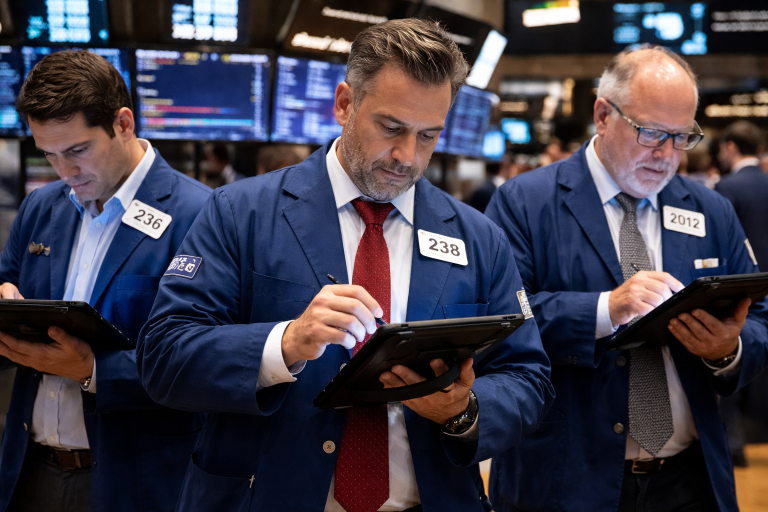
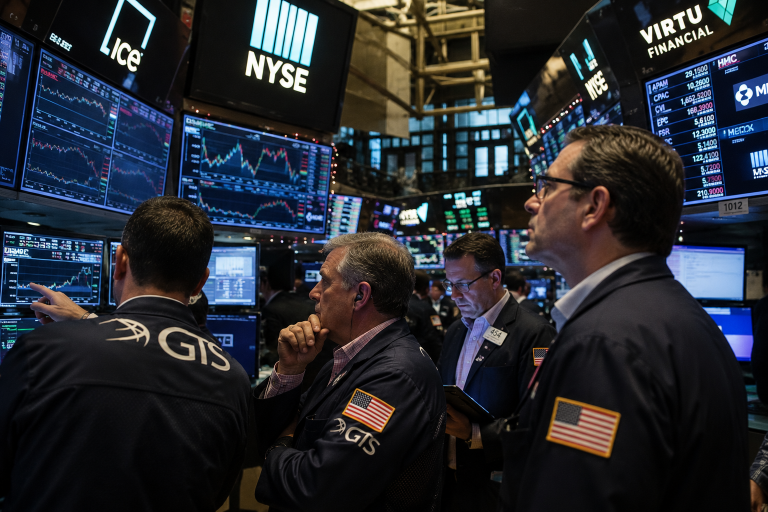
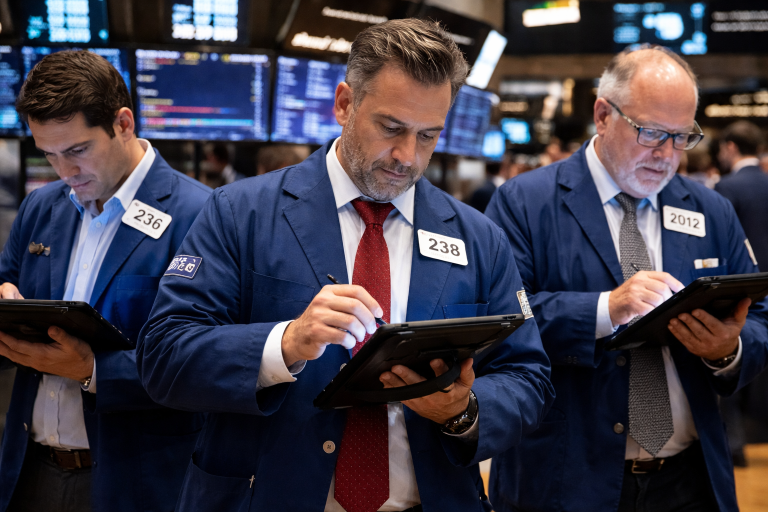
US stocks opened higher on Thursday as investors returned to beaten-down technology shares following a sharp selloff, though gains were tempered by rising geopolitical tensions in the Middle East and higher oil prices.
The Dow Jones Industrial Average added 246 points. The S&P 500 rose 0.29%, while the Nasdaq Composite gained 0.28%.
The rebound came after Wednesday’s steep decline, when major Wall Street indexes fell more than 1% amid another selloff in semiconductor stocks.
The S&P 500 has now fallen about 4% since reaching a record closing high in early June, while technology stocks have entered correction territory after declining 10% from their recent peak.
Chip stocks rebound after sharp selloff
Semiconductor shares led Thursday’s gains. Nvidia, Intel and Micron Technology advanced between 0.62% and 8%, while the iShares Semiconductor ETF climbed about 3%.
The brokerage cited growing demand for central processing units and opportunities tied to the rise of agentic artificial intelligence.
The sector’s recovery follows a difficult week for chip stocks.
The semiconductor ETF had already suffered a 10% decline on Friday, prompting some investors to question whether the powerful rally fueled by artificial intelligence demand had run its course.
Market participants are also looking ahead to the highly anticipated market debut of SpaceX on Friday.
The company is expected to be valued at roughly $1.75 trillion to $1.8 trillion, making it the largest public debut on record.
Some traders believe recent weakness in semiconductor shares may partly reflect investors raising cash to participate in the offering.
Iran tensions push oil higher
Despite the rebound in equities, geopolitical concerns continued to weigh on sentiment.
West Texas Intermediate crude futures rose nearly 1% to around $90 per barrel after President Donald Trump signaled potential military action against Iran.
Trump said the United States will hit Iran “very hard tonight” and later stated on Truth Social: “At some point in the not too distant future, we will be taking Kharg Island, and other oil infrastructure points, and assume total control of their Oil and Gas Markets.”
The comments followed additional US military action in the region. US Central Command said it launched more “self-defense strikes” against Iran late Wednesday at Trump’s direction.
The escalation caused stock futures to trim some of their earlier gains as investors assessed the potential economic consequences of higher energy prices.
Economic data and sector rotation remain in focus
Investors also digested fresh economic data showing producer prices increased more than expected in May.
The producer price index rose 1.1%, above economists’ expectations of 0.7%, while core inflation, excluding food and energy, came in at 0.4%.
Separately, new claims for unemployment benefits increased modestly last week.
The Federal Reserve is widely expected to leave interest rates unchanged at its June 17 policy meeting, although markets continue to price in at least one quarter-point rate increase before year-end.
Outside the semiconductor sector, Oracle shares fell 12% after the company unveiled plans to raise an additional $20 billion in equity and debt financing to support artificial intelligence infrastructure investments.
Meanwhile, corporate travel platform Navan surged 11% after raising its full-year revenue and operating income forecasts, citing strong business travel demand and continued growth among enterprise customers.
Oil prices plunged more than 3% on Tuesday as Iran and Israel announced a halt in attacks, thereby easing tensions in the Middle East.
Gold prices were largely unchanged after slipping to a two-and-a-half month low in the previous session. Silver also continued its fall below $70 per ounce.
Meanwhile, copper on the London Metal Exchange rose more than 1% as optimism over de-escalation in Middle East tensions boosted sentiments.
At the time of writing, the three-month copper contract on LME was at $13,756.13 per ton, up 1.1%, while aluminium was 0.7% down at $3,569 per ton.
Oil slips
Oil prices slipped on Tuesday, giving back the gains from the previous session after Iran and Israel announced they had paused attacks following an appeal from US President Donald Trump.
Both sides, however, warned that hostilities could resume at any time.
The renewed Israeli strikes on Iran and attacks in Lebanon over the weekend had driven prices up by about 5% on Monday. But with no fresh catalysts, crude retreated once the announcement of a halt in fighting came through.
Brent crude oil was last at $90.96 per barrel, down 3.4%, while West Texas Intermediate plunged 4% to $87.62 per barrel.
Tehran has continued to block most shipping through the Strait of Hormuz, a vital waterway that, before the war, carried around one‑fifth of the world’s crude oil and liquefied natural gas.
Washington has imposed its own blockade of Iranian ports, further tightening flows.
On Monday, US forces disabled an oil tanker in the Gulf of Oman after it attempted to sail to an Iranian port in violation of the blockade, according to the US military.
Adding to the downward pressure was weaker demand from China. Imports of crude fell 29% last month to their lowest level in eight years.
In April, shipments had already dropped to a multi‑year low of 9.3 million barrels per day, down sharply from an average of 11 million barrels per day before the US‑Israeli war on Iran.
Refiners in the world’s largest oil‑importing nation have been drawing on reserves to offset the decline.
Gold falls
Despite rising for a brief period earlier on Tuesday, gold could not defend its gains. Prices slipped again and extended losses from the previous session.
Earlier in the day, the US dollar index slipped 0.3% against major peers, making gold priced in dollars more attractive to buyers using other currencies.
Meanwhile, developments in the Middle East raised hopes of a peace deal, pushing oil prices lower after Iran and Israel announced they had paused attacks following an appeal from US President Donald Trump.
Softer oil prices could ease inflation concerns, potentially opening the door for central banks to cut interest rates and boosting the appeal of non-yielding gold.
After last week’s strong jobs report, investor attention has shifted to key inflation readings, including the May US Consumer Price Index due Wednesday and the Producer Price Index on Thursday, which will provide further clues on the Federal Reserve’s policy outlook.
According to CME’s FedWatch tool, traders are currently pricing in about a 70% chance of a US rate hike in December.
“Should the US inflation data for May also surprise on the upside on Wednesday, the gold price is likely to fall further,” Carsten Fritsch, commodity analyst at Commerzbank AG, said in a report.
This also increases the potential for a recovery later in the year, should, as we expect, the Fed not raise interest rates. However, as long as expectations of interest rate hikes prevail, gold is likely to remain on the back foot.
At the time of writing, the gold contract on COMEX was at $4,350.10 per ounce, down 0.3%, while silver was 1% down $67.905 an ounce.
Astera Labs stock price has gone parabolic in the past few months, mirroring the performance of the semiconductor industry. ALAB jumped to $346 on Monday, up by 253% from its lowest point this year, with its valuation jumping from $16.6 billion in April to $60 billion today. Still, the company faces some major risks, with analysts predicting a pullback.
Astera Labs stock has jumped amid the semiconductor industry boom
Astera Labs is a top player in the technology industry, where it builds the connective tissue inside data centers. Instead of making GPUs, the company makes chips and software that enable GPUs, CPUs, memory, and networking gear to communicate with each other well.
The company solves a major problem that has existed in the data center industry for a while. Modern AI platforms use thousands of chips that work together, and moving data between them is a key bottleneck.
Astera Labs stock price has, therefore, surged this year because of the ongoing data center boom in the United States and other countries. Top companies like Meta Platforms, Microsoft, Google, and Amazon are spending over $750 billion in their data centers this year.
The most recent numbers showed that Astera Labs’ business was firing on all cylinders. Its revenue jumped by 14% sequentiually and 93% on a YoY basis, making it one of the fastest-growing companies in the industry. It made over $304 million in revenue, beating what analysts were expecting by far.
This growth happened as the company announced the Scorpio X-Series 320-lane Smart Fabric Switch. It also expanded its Scorpio P-Series PCIe-6 Fabric family that now spans from 32 to 320 lane configurations.
Astera Labs made a net income of $110 million, representing an operating margin of 36.2%. Analysts believe that this growth momentum will continue as the data center boom gains steam.
The average estimate is that the company’s revenue jumped by 87% to $360 million. It will then grow by 78% YoY to over $410 million. As a result, the annual revenue growth is expected to grow by 81% this year followed by 42% next year. This means that it will make $1.55 billion this year, followed by $2.19 billion next year.
Still, the main challenge for Astera Labs stock is that it is highly overvalued. Data shows that it trades with a forward price-to-earnings ratio of 153, much higher than the sector median of 32. The forward PEG ratio stands at 2.31, also higher than the sector median of 1.36.
ALAB stock price technical analysis
Astera Labs stock chart | Source: TradingView
The daily chart shows that the ALAB share price has surged from a low of $98.17 in March to a high of $372 this year. It recently surged above the crucial resistance level at $262, its highest point in September last year.
The Relative Strength Index has moved from the overbought level of 83 to the current 65. In some instances, it is common for a highly overbought stock to retreat amid profit-taking.
Astera Labs stock has also moved further away from its historical moving averages. For example, its current price of $346 is much higher than the 100-day Exponential Moving Average (EMA) of $203. This means that it may retreat because of a concept known as mean reversion.
If this happens, the next key level to watch will be at $262, its highest point in September. This target is slightly above the average estimate among analysts, which stands at $233.
US semiconductor stocks began recovering on Monday after suffering a brutal selloff on Friday that wiped roughly $1.3 trillion from the sector’s value, as investors debated whether the decline marked a healthy correction or the start of a deeper downturn for one of Wall Street’s strongest trades.
The technology-heavy Nasdaq tumbled 4.2% on Friday, marking its steepest one-day decline in months, while the Philadelphia Semiconductor Index plunged 10%, its worst session since March 2020.
Semiconductor names bounce back as Huang reassures investors
By Monday, however, some of the sector’s biggest names were showing signs of recovery.
Nasdaq futures climbed more than 1.5% in premarket trading, while several semiconductor stocks rebounded sharply from Friday’s losses.
Micron Technology rose about 8% in premarket trading after plunging 14% during Friday’s session.
NVIDIA gained nearly 3%, while Advanced Micro Devices advanced around 4%.
The recovery suggested investors may be viewing the selloff as a temporary reset rather than a fundamental shift in the outlook for artificial intelligence-related spending.
Some of Monday’s optimism appeared tied to comments from Nvidia Chief Executive Jensen Huang, who sought to reassure investors that the long-term AI story remains intact despite recent market turbulence.
Speaking in Seoul, South Korea, Huang described the market decline as an opportunity rather than a reason for concern.
“We’re at the beginning of it, and whatever happened to the stock market, you should be very happy because now you can buy at a discount,” Huang said, referring to the broader artificial intelligence opportunity.
Analysts remain constructive on AI demand
Several market strategists echoed Huang’s optimism, arguing that the underlying drivers of the AI boom remain firmly in place.
UBS Global Wealth Management’s chief investment officer Mark Haefele said the recent volatility had not altered the broader investment case for technology stocks.
“Despite renewed anxiety over rates, equity issuance, and geopolitics, we expect the rally to resume,” Haefele wrote.
According to UBS, strong corporate fundamentals continue to support equity markets, particularly within technology.
The firm expects spending on artificial intelligence infrastructure and applications to remain elevated as businesses increasingly adopt the technology.
Haefele also argued that investors may be overstating the likelihood of aggressive monetary tightening from central banks, a concern that has weighed heavily on growth stocks in recent sessions.
Higher interest rates typically reduce the appeal of technology shares because they lower the present value of future earnings.
Historical data suggests resilience
Some analysts point to market history as a reason for optimism.
“The S&P 500 recently posted a gain of more than 19% over two months off the late March lows. According to Carson Investment Research data going back to 1950, that has only happened seven times before, and on every single occasion, the index was higher one month, three months, six months, and twelve months later,” Beauchamp said.
He added that the average return one year after similar signals exceeded 40%, with a 100% historical success rate.
The earnings backdrop also remains supportive, according to Beauchamp.
S&P 500 earnings per share are projected to grow roughly 23% in 2026, a pace achieved only a handful of times in recent decades.
Historically, years with earnings growth above 20% have generally coincided with strong equity-market performance.
Volatility is likely a healthy pause, but 2018 remains a cautionary comparison
Despite the optimistic outlook, Beauchamp cautioned that risks remain.
The primary concern is that markets could face a scenario similar to 2018, when the Federal Reserve continued raising interest rates despite strong economic growth, ultimately contributing to a market downturn.
“The sole exception was 2018, when the Fed was hiking aggressively into late-cycle strength. The 2018 analogy is clearly the risk scenario traders are now stress-testing,” Beauchamp said.
He added that while historical evidence favors the view that the latest decline represents a temporary pause within a broader bull market, investors should not dismiss the possibility of a more prolonged correction.
“Whether this week’s volatility is the beginning of something more damaging, or simply the healthy pause that strong rallies require, is genuinely uncertain. The weight of historical evidence points firmly toward the latter,” he said.
“But the 2018 playbook is close enough to current conditions that it cannot be dismissed, and traders should be sizing their positions accordingly rather than assuming history will rhyme neatly,” he concluded.
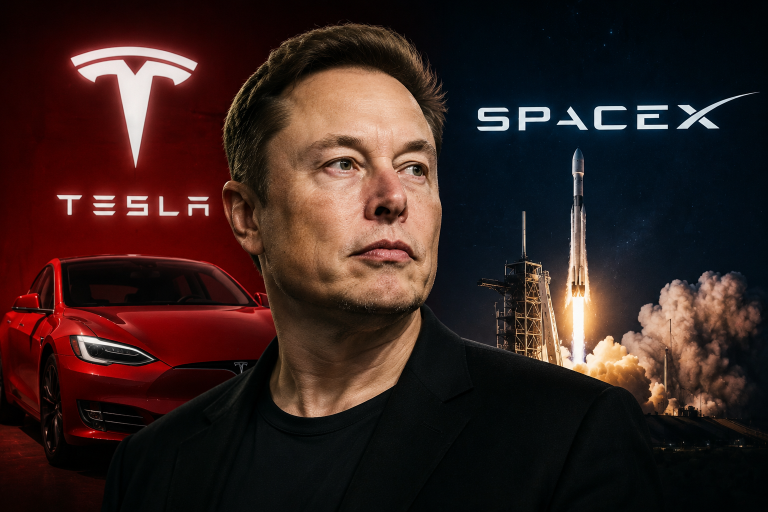
SpaceX is just days away from making stock market history.
Elon Musk’s rocket, satellite, and artificial intelligence company is expected to begin trading on Nasdaq on June 12 after pricing its initial public offering the day before.
With a targeted fundraise of $75 billion and a valuation approaching $1.8 trillion, the offering is set to become the largest IPO ever.
The excitement surrounding the deal has revived a familiar question among investors: Is SpaceX a good investment?
SpaceX has fixed its SpaceX IPO price at $135 per share and plans to sell 555.6 million shares.
At that price, the company would be valued at approximately $1.8 trillion.
That would give SpaceX a cap larger than Tesla’s current valuation and immediately place it among the ten most valuable publicly traded companies in the United States.
The company has taken an unusual approach by announcing a fixed price ahead of its roadshow rather than marketing a price range.
The move reflects confidence in investor demand as bankers begin gathering orders ahead of final pricing.
Institutional investors will spend the coming days evaluating whether the proposed SpaceX valuation is justified by the company’s future growth prospects.
The bank also projects that total company revenue could reach $474 billion by the end of the decade.
Those forecasts help explain why some investors are willing to support a SpaceX market cap that appears disconnected from current financial results.
The company currently generates most of its revenue from Starlink subscriptions and launch services.
However, investors are increasingly being asked to value SpaceX based on what its AI business could become rather than what it is today.
Bloomberg reported that many investors attending a recent JPMorgan event appeared enthusiastic about Musk’s long-term vision despite questions around valuation and execution.
Participants described SpaceX as a generational company and expressed confidence in Musk’s ability to create entirely new industries.
That optimism is also evident among major investors.
ARK Invest’s Brett Winton recently described SpaceX as “the most important company in the world in terms of what the future is going to look like,” while billionaire investor Philippe Laffont has suggested SpaceX could become part of the next generation of market-leading technology stocks.
Invest in SpaceX now with eToro
The bear case: is SpaceX IPO overvalued?
The biggest concern for prospective investors is straightforward: Is SpaceX IPO overvalued?
At the targeted valuation of roughly $1.8 trillion, SpaceX would trade at approximately 94 times its 2025 revenue of $18.7 billion.
For comparison, the broader S&P 500 trades at a fraction of that multiple.
Even Tesla, which commands one of the highest valuations among major public companies, trades at significantly lower revenue multiples.
Critics argue that investors are being asked to pay today for profits and businesses that may not fully materialise for years.
The research firm’s analysts argued that the market may be assigning excessive value to future AI opportunities while underestimating competitive risks from companies such as OpenAI and Anthropic.
The valuation gap has become central to the debate over whether SpaceX’s IPO is overvalued, is the wrong question, or the most important one.
Adding to concerns is the fact that SpaceX remains unprofitable.
The company reported a loss of $4.9 billion in 2025 as it continued investing heavily in artificial intelligence infrastructure.
Retail investors are getting a rare opportunity
Unlike many blockbuster IPOs, SpaceX is making a significant effort to attract retail investors.
The company launched a dedicated IPO website directing prospective buyers to brokerages including Robinhood, SoFi, Fidelity, Schwab, and E*Trade.
According to the Financial Times, those platforms will feed daily demand information back to the underwriting banks as the offering progresses.
The approach could broaden participation in what has traditionally been an institutional investor-driven process.
It also means that ordinary investors will have an opportunity to buy shares closer to the IPO price than is typical in many high-profile offerings.
Invest in SpaceX now with eToro
Is SpaceX a good investment?
Whether SpaceX is a good investment ultimately depends on an investor’s time horizon and risk tolerance.
The bullish case centres on Starlink’s continued growth, SpaceX’s leadership in commercial spaceflight, and the possibility that its AI operations become one of the largest technology businesses in the world.
The bearish case focuses on valuation. A SpaceX market cap approaching $1.8 trillion leaves little room for disappointment if revenue growth slows or AI ambitions fail to meet expectations.
For investors considering the IPO, the next major catalyst will be June 11, when final pricing is expected.
Demand during the roadshow could offer the clearest indication yet of whether Wall Street believes the proposed SpaceX valuation is justified—or whether concerns that the SpaceX IPO is overvalued begin to gain traction once the shares start trading.
The countdown to SpaceX’s long-awaited stock market debut is entering its final days.
Sixteen years ago, Tesla went public on the stock market, and today, Elon Musk is preparing to take another company public, which is already larger, more ambitious, and arguably far more controversial from a valuation standpoint.
Tesla’s IPO raised about $226 million and valued the electric vehicle maker at roughly $1.7 billion.
Today, Tesla is worth more than $1.5 trillion, representing a staggering 1,000-fold increase.
For investors weighing whether to participate in what could become the largest IPO in history, Tesla’s journey offers both inspiration and caution.
Yet while the two companies share a leader, their public-market debuts could hardly be more different.
Tesla’s journey from a startup to a global giant
When Tesla filed to go public in 2010, it was still a relatively obscure startup.
The company was only about six years old and best known for the Roadster, a $109,000 electric sports car sold in limited numbers.
Elon Musk, who today boasts a net worth exceeding $800 billion, drew a base salary of just $33,280 a year, according to Tesla’s IPO filing.
Tesla had a straightforward mission. It had hoped to prove that electric vehicles could compete with gasoline-powered cars and eventually become mainstream.
At the time, many investors remained unconvinced.
The company had sold only a few vehicles and was preparing to launch the Model S sedan, which it hoped would dramatically expand its addressable market.
Tesla had secured around 2,000 reservations for the Model S, a premium four-door sedan with a starting price of $49,900.
The central question facing investors was simple: “Can Tesla build and sell enough cars to survive?”
That proposition seems obvious today.
In 2010, it was anything but.
Tesla became the first US automaker to go public since Ford Motor Co.’s debut in 1956, arriving at a time when the broader market viewed electric vehicles with scepticism.
When Tesla went public in 2010, it was a tiny company by global market standards.
Its valuation represented just 0.003% of global GDP.
With a market capitalization of more than $1.5 trillion, it now represents roughly 1.5% of global GDP.
Ford, meanwhile, is worth only about 3% to 4% of Tesla’s market value.
SpaceX enters public markets from a vastly different position.
Rather than being a small company with enormous aspirations, it is already the most valuable private space company in the world.
Founded in 2002, SpaceX has spent more than two decades building multiple businesses before seeking public capital.
The company now operates Starlink satellite internet, rocket launch services, government and defense contracts, space infrastructure projects, xAI and artificial intelligence operations, and future AI and orbital data-center initiatives.
Revenue reached approximately $18.7 billion in 2025, with Starlink contributing about $11.4 billion.
Unlike Tesla’s IPO, which was about proving a business model, SpaceX’s offering is about proving its valuation.
The question investors face today is: “Can SpaceX grow enough to justify a $1.75 trillion valuation?”
The valuation gap is enormous
The difference becomes particularly striking when viewed through valuation multiples.
Tesla’s IPO valuation implied roughly 15 times annual sales.
SpaceX is seeking a valuation exceeding 90 times sales. The premium is extraordinary.
Investors are not paying for current profitability.
In fact, SpaceX openly acknowledges that profitability may remain elusive.
In its prospectus, the company stated it has “a history of net losses and may not achieve profitability in the future.”
SpaceX reported revenue of $18.67 billion in 2025 but posted a net loss of $4.94 billion, compared with a profit of $791 million the year before.
Losses widened further in the first quarter of 2026 as spending increased on artificial intelligence infrastructure and Starship development.
Much of the valuation rests on future possibilities: AI infrastructure dominance, massive Starlink expansion, future space-based data centers, space infrastructure services, and potential Mars-related opportunities
The filing describes plans involving as many as one million AI Sat Mini satellites in low Earth orbit and ties the project to ambitions of advancing humanity toward a “Kardashev Type II civilization.”
Critics view many of those assumptions as highly speculative.
What valuation experts think
Among those examining the numbers closely is Aswath Damodaran, the New York University professor often referred to as the “dean of valuation.”
Before reviewing the prospectus, Damodaran estimated SpaceX was worth around $1.2 trillion.
After analyzing the filing, he modestly increased that estimate.
“If I were to summarize the impact of the prospectus on my SpaceX story, it would be that it has made the story bigger, but also more volatile,” he said.
His revised valuation stands at roughly $1.3 trillion, or about $100 per share.
Damodaran also addressed criticism of SpaceX’s lofty valuation.
“SpaceX is a company with small revenues and large losses, and paying a hundred times revenues for it (which is where a $1.8 trillion pricing would put it) seems foolhardy,” he said.
However, he argued that investors who insist exclusively on traditional valuation metrics often end up concentrated in mature or declining businesses.
Still, he is not buying at current levels.
“It is worth remembering that Facebook was selling at half its offering price a few months after its IPO, and that Uber lost more than 50% of its market cap in the year after its public offering, moving both companies from over to under valued,” he said.
Morningstar’s discounted cash flow analysis values SpaceX at about $780 billion instead, less than half of the company’s proposed $1.75 trillion IPO valuation and well above recent private-market secondary valuations.
Tesla was losing money too
Supporters of SpaceX point out that Tesla was hardly a model of profitability when it went public.
In the first nine months of 2009, Tesla lost $31.5 million, though that represented an improvement from a $57.3 million loss the year before.
Revenue climbed sharply to $93.4 million from just $580,000.
Tesla warned investors it expected to continue losing money until significant deliveries of the Model S began in 2012.
One of Tesla’s defining moments arrived in May 2013, when the stock surged 81% after reporting its first quarterly profit.
The achievement was modest, but it signaled that the company could eventually build a sustainable business.
However, the company still did not become consistently profitable until 2018.
Ruth Foxe-Blader, managing partner at Citrine Venture Partners, told the BBC: “It’s not shocking for a project like this to be loss-making, even at the point of IPO.”
Why Tesla may have been the safer investment
Ironically, despite being the riskier business operationally, Tesla may have been the safer investment from a valuation perspective.
When Tesla went public at roughly $1.7 billion, the upside was enormous.
A rise to:
$17 billion would deliver a 10-fold return
$170 billion would generate a 100-fold return
$850 billion would create a 500-fold return
History proved those outcomes were not impossible.
An investor who put $10,000 into Tesla at its IPO and held the shares would have owned stock worth nearly $3 million by June 2025.
The same investment in the S&P 500 would have grown to roughly $57,000.
Tesla’s rise created an entire class of millionaires known as “Teslanaires.”
SpaceX starts from a very different place. A 10-fold return would require a market value of $17.5 trillion.
A five-fold return would imply a company worth $8.75 trillion.
Those figures would exceed the current market capitalization of most national stock markets.
The sheer scale creates a natural ceiling on future returns.
Lessons from history
Tesla’s IPO story was ultimately simple: “Electric cars will replace gasoline cars.”
SpaceX’s narrative is considerably broader.
Investors are being asked to believe that communications, artificial intelligence, satellite infrastructure, orbital computing, and potentially humanity’s expansion beyond Earth will all converge around one company.
Goldman Sachs reportedly estimates that SpaceX’s AI business alone could generate more than $300 billion in annual revenue by 2030.
Whether those projections materialize remains one of the defining questions surrounding the IPO.
History offers some reasons for caution.
Research by finance professor Jay Ritter has shown that IPOs launched at extremely high revenue multiples have historically tended to underperform the broader market in the years that follow.
Companies that listed at more than 40 times sales have generally lagged significantly over time.
SpaceX is seeking to go public at more than 90 times its 2025 revenue.
“With a small initial float boosted by almost every investment bank on the planet, buoyant investor appetite for AI infrastructure bids, and an unprecedented path to inclusion in the Nasdaq 100 Index just 15 trading days after the IPO, we expect SpaceX’s share price will likely survive separation and even ascent toward orbit, at least for a time,” the analysts said.
The bigger test, however, may come after the initial excitement fades.
“Max Q, the moment of greatest atmospheric pressure on a launch vehicle, will come for SpaceX’s stock in the months following the IPO, when successive tranches of stock held by private investors and employees are slated to become available for sale into the public market,” Morningstar said.
As additional shares enter the market following lock-up expirations, investors could see a clearer picture of where sustainable demand for the stock lies.
“We think long-term investors eager to participate in SpaceX’s future endeavors and potential success will have opportunities to do so with a greater margin of safety than the initial offering is likely to provide,” the analysts added.
US stocks moved lower on Friday as a stronger-than-expected May jobs report dampened expectations for interest rate cuts and triggered renewed selling across semiconductor stocks.
The Dow Jones Industrial Average was up 20 points while the S&P 500 fell about 0.6%, and the Nasdaq Composite dropped 1.07%.
According to the Bureau of Labor Statistics, employers added 172,000 jobs during the month after an increase of 115,000 in April.
Economists surveyed by Reuters had expected 85,000 new jobs, while a Dow Jones poll had forecast 80,000.
The unemployment rate held steady at 4.3%, matching market expectations.
Strong jobs data shifts Fed expectations
The stronger labor market report prompted investors to reassess the outlook for US monetary policy.
Money markets now assign a 98% probability that the Federal Reserve will raise interest rates by 25 basis points before the end of the year, according to market pricing.
Before the employment report, those odds had been closer to 60%.
Treasury yields climbed in response, with the benchmark 10-year yield rising above 4.5% and the 30-year Treasury yield moving above 5%.
The report arrives ahead of Federal Reserve Chair Kevin Warsh’s first policy meeting later this month as policymakers continue to navigate elevated inflation and economic uncertainty linked partly to the conflict in the Middle East.
Chip stocks retreat after recent rally
Technology shares, particularly semiconductor companies, led the market lower.
Nvidia fell about 2%, while Intel, AMD, Micron Technology, and Broadcom declined between 3% and 5.5%.
Marvell Technology also dropped more than 6%.
Broadcom fell 3% after tumbling 12.5% on Thursday following weaker-than-expected quarterly revenue, adding to concerns that valuations across AI-related stocks may have become stretched.
Semiconductor stocks have been a major driver of Wall Street’s rebound from its March lows, supported by strong AI-related demand and improving corporate earnings.
Geopolitics and corporate news remain in focus
Investors also continued to monitor developments in the Middle East after Hezbollah rejected a new ceasefire proposal for Lebanon, while Israel indicated it would keep troops in place, complicating US efforts to advance negotiations with Iran.
Citi said it was trimming equity exposure following the market’s strong rally, citing rising inflation risks and investor positioning, while maintaining a constructive longer-term outlook supported by AI-driven earnings growth.
Among individual stocks, Lululemon Athletica fell nearly 8.7% after lowering its annual profit forecast and issuing second-quarter earnings guidance below Wall Street expectations.
Cooper Companies rose 8% after the contact lens manufacturer reported second-quarter results that exceeded analyst estimates.
Meanwhile, S&P Global confirmed it would not alter eligibility rules for its major indexes, effectively ruling out an immediate inclusion for SpaceX in the S&P 500 following its planned public debut.
Investors also awaited the results of the latest S&P Dow Jones Indices rebalancing, with Marvell Technology viewed as one of the potential additions to the benchmark index.
If current market moves persist through the session, the S&P 500 would post its first weekly decline since April, while the Nasdaq Composite would also finish the week lower.
The Dow Jones Industrial Average, however, remained on track for a third consecutive weekly gain.
Trafigura Group delivered a strong financial performance in the first half of its 2026 financial year, posting a net profit of $4.1 billion despite challenging global conditions marked by geopolitical tensions and supply chain disruptions.
Trafigura highlighted that the three-month period ending 31 December 2025 marked its second-strongest first quarter on record.
The Group’s equity rose to a robust $17.5 billion, supported by disciplined capital management, while liquidity reached a record $19.4 billion, including a new $3 billion contingent facility.
Richard Holtum, Trafigura’s Chief Executive Officer, attributed the results to operational excellence rather than simply elevated commodity prices.
“These results demonstrate the value of the diversified platform we have built, and the importance of disciplined execution,” he said.
When supply chains are under strain, our teams work harder and move faster to identify solutions and manage increased risks. Our results are driven by the complexity and cost of delivering those solutions, rather than by elevated commodity prices.
Well positioned before Middle East conflict
A significant portion of the profits was secured before the escalation of the Iran conflict.
Stephan Jansma, Trafigura’s Chief Financial Officer, noted: “Following a very strong first quarter, a substantial portion of the period’s profits had already been secured before the conflict in the Middle East began, leaving the Group well positioned to respond when conditions changed. This reflected not only strong near-term performance, but also several years of sustained effort to strengthen the business.”
The company is paying a record dividend to its employee-shareholders, reflecting confidence in its capital position and performance.
Outlook remains cautious
While the first half delivered exceptional results, Trafigura struck a measured tone for the remainder of the year.
“Performance has continued to be good in the second half to-date. However, the external environment is difficult to forecast, with ongoing geopolitical tensions and market volatility presenting a wide range of potential outcomes,” the company stated.
With record liquidity and a strong balance sheet, Trafigura believes it is well placed to capitalise on opportunities and manage risks arising from current market conditions.
Source: Trafigura
Asset optimisation continues
While trading performance remained robust, Trafigura recorded $700 million in impairment charges during the first half, primarily related to the management of its assets division.
The charges were linked to the divestment of assets held by its metals subsidiary, Nyrstar, in Tennessee, as well as Greenergy’s acquisition of French fuel supplier Armorine.
The company said it continues to review and optimise its asset base.
Jansma said Trafigura remains satisfied with its roughly $10 billion asset portfolio but intends to pursue further optimisation opportunities.
The broader commodities trading sector has also benefited from heightened market volatility.
Rival Gunvor said it generated gross profit in the first quarter equivalent to its entire 2025 total of $1.63 billion, with Chief Executive Gary Pedersen previously pointing to an increase in what he described as “constructive volatility.”
Sustainability and long-term focus
Beyond financial metrics, Trafigura continues to invest in renewable energy projects and technologies through entities such as MorGen Energy and Nala Renewables, aligning with the global energy transition while maintaining its core commodities trading business.
The Group, which employs around 14,500 people across more than 150 countries, remains focused on building resilient and sustainable supply chains.
Overall, Trafigura’s record first-half performance demonstrates the strength of its business model in volatile times.
While near-term uncertainties persist due to geopolitical risks, the company enters the second half with significant financial firepower and operational flexibility.
Its ability to deliver solutions in strained supply chains positions it favourably to navigate whatever challenges the remainder of 2026 may bring.
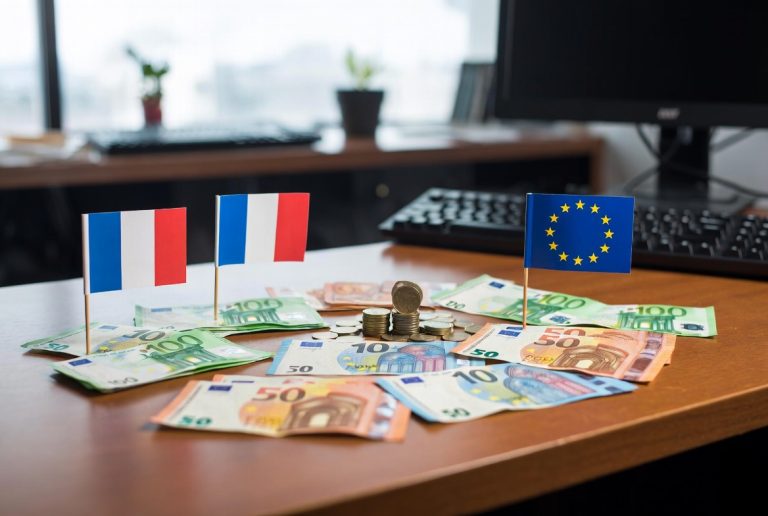
France has maintained its position as Europe’s leading destination for foreign direct investment projects, according to the latest EY Europe Attractiveness Survey.
The country attracted 852 new investment projects in 2025, far ahead of its closest rivals, even as the overall number of projects across Europe fell to the lowest level in 11 years, the survey said.
Foreign investment is widely regarded as a vital driver of economic growth, innovation, and job creation.
Governments across the continent are competing aggressively with incentives, tax breaks, and high-profile summits to lure international companies.
France strengthens lead with Choose France initiative
President Emmanuel Macron’s “Choose France” campaign, launched in 2018, continues to deliver results. At this year’s summit, Macron announced that foreign companies had pledged investments worth a record €93 billion.
Despite a 17% drop in new projects to 852 in 2025, France comfortably retained the top spot. The country has successfully positioned itself as a stable and attractive hub for international investors.
UK and Germany follow as investment slows across Europe
The United Kingdom ranked second with 730 projects in 2025, down 14% from the previous year. Germany placed third with 548 projects, a 10% decline and its lowest level since 2009.
The long-term trend for Germany is particularly concerning. Compared to 2019, the number of foreign investment projects has plunged 44%, a steeper fall than in France (-28%) or the UK (-34%).
Europe as a whole recorded 5,026 new investment projects in 2025, down 7% from 2024.
This marked the lowest annual total in 11 years, reflecting broader economic uncertainties, geopolitical tensions, and slower global growth.
Why France continues to win
Analysts attribute France’s resilience to proactive government policies, improved business environment reforms, and its central position in the European Union.
The “Choose France” initiative has helped the country stand out by offering tailored incentives and high-level engagement with investors.
In contrast, Germany continues to face challenges, including high energy costs, regulatory complexity, and weaker domestic demand, which appear to be deterring some foreign investors.
The UK has benefited from post-Brexit flexibility in certain sectors but continues to face headwinds from labour shortages and trade frictions.
Broader implications for European competitiveness
The EY survey tracks actual announced investment projects rather than capital flows, providing a clearer picture of real economic activity on the ground.
These projects typically involve new factories, research centres, and expansions that create direct jobs and strengthen supply chains.
The overall decline in projects across Europe signals growing challenges in attracting foreign capital at a time when many economies are seeking to boost growth and innovation.
Competition from the United States, Asia, and emerging markets remains intense.
Outlook for 2026
With global economic conditions still uncertain, European nations are expected to intensify their efforts to attract foreign investment.
France appears well-positioned to defend its lead, while the UK and Germany will need to address structural issues to regain momentum.
As governments prepare new incentives and policy measures, the battle for foreign investment projects is likely to heat up further in 2026.
Success in this area could prove decisive for Europe’s economic recovery and long-term competitiveness.
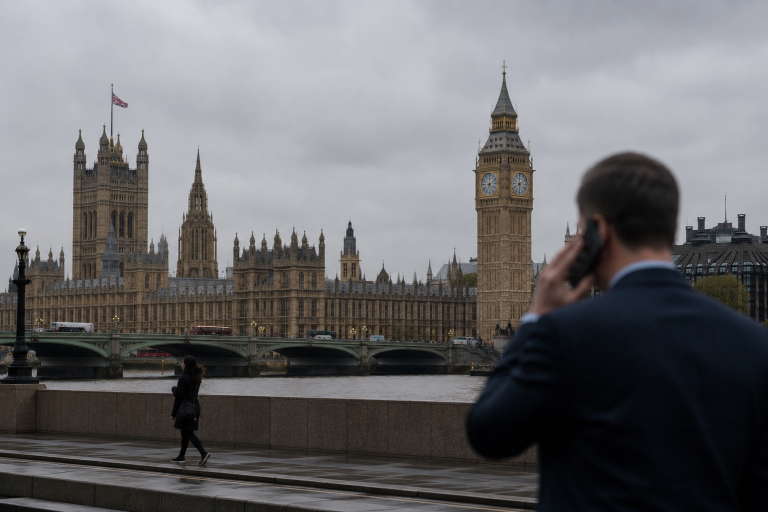
British services firms recorded a modest decline in activity in May as rising costs linked to the Iran war and weakening demand weighed on business conditions, according to a survey released on Wednesday.
The S&P Global Purchasing Managers’ Index (PMI) for Britain’s services sector fell to 49.3 in May from 52.7 in April.
The reading marked the first contraction in output since April 2025.
However, it came in above the preliminary flash estimate of 47.9.
A PMI reading below 50 indicates contraction, while a reading above 50 signals growth.
The decline in services activity came on the same day that the OECD slightly raised its growth forecast for Britain in 2025.
The organisation increased its projection to 0.9% from the 0.7% forecast issued shortly after the outbreak of the Middle East conflict.
Despite the deterioration in services activity, the downturn indicated by the PMI survey was less severe than that seen in the euro zone.
Survey respondents reported weaker demand from both domestic and overseas customers during May, contributing to the slowdown in business activity.
The composite PMI, which combines services and manufacturing data, was revised higher to 49.7 from a preliminary estimate of 48.5.
However, the reading remained below April’s level of 52.6, signalling an overall decline in private-sector activity.
Inflation pressures remain elevated
While activity weakened, inflationary pressures remained strong across the services sector.
The PMI measure of input cost inflation eased slightly in May but remained at its second-highest level since December 2022, a period that followed Russia’s full-scale invasion of Ukraine.
Businesses reported that higher energy, fuel, and transport costs, along with rising salaries, contributed to the increase in operating expenses.
Companies responded by passing these costs on to customers.
The survey showed firms raised prices at the second-fastest pace in three years, only marginally below the increase recorded in April.
Tim Moore, economics director at S&P Global Market Intelligence, said ongoing concerns about inflation and geopolitical risks continued to affect sentiment.
“Worries about a prolonged spike in inflationary pressures, combined with elevated geopolitical tensions and subdued demand, continued to weigh on business activity expectations in May,” Moore said.
Bank of England faces policy dilemma
Despite the inflation concerns highlighted by the survey, the Bank of England is widely expected to leave interest rates unchanged at its upcoming policy meeting.
Markets on Tuesday priced in a 90% probability that the central bank would keep borrowing costs at 3.75% when it announces its decision on June 18.
Governor Andrew Bailey has taken the view that policymakers have time to assess the economic impact of recent developments before making further decisions on interest rates.
However, Bank of England policymaker Megan Greene suggested that inflation pressures may be extending beyond energy-related sectors.
Speaking at the University of Derby on Tuesday, Greene said services firms are not heavily exposed to energy costs were still increasing prices significantly.
Confidence falls, and hiring continues to decline
Business sentiment regarding the year ahead weakened further in May.
According to S&P Global, confidence fell to its lowest level since April last year, when sentiment dropped sharply following the announcement of a broad range of trade tariffs by US President Donald Trump.
Employment conditions also remained under pressure.
Hiring declined for the 20th consecutive month, marking the longest uninterrupted period of job losses since early 2010.
Matt Swannell, chief economic adviser to forecasters ITEM Club, said policymakers were facing increasingly difficult choices.
The survey highlights the challenge facing Britain’s economy, where slowing activity, persistent inflation pressures, and weakening confidence are occurring simultaneously, creating a difficult environment for both businesses and policymakers.