
Author

admin

Browsing

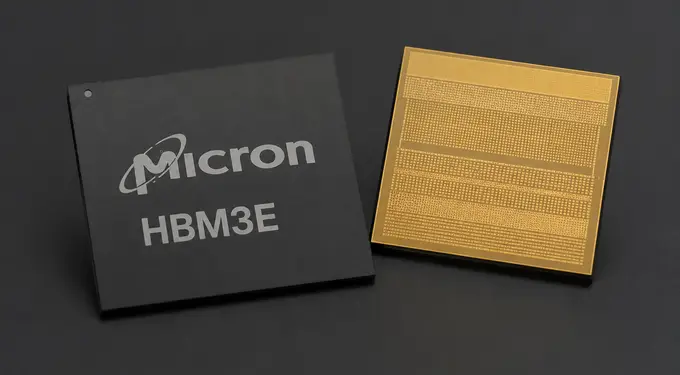
Micron Technology’s MU shares fell sharply on Friday, giving up part of the gains recorded earlier in the week despite the memory chipmaker reporting stronger-than-expected quarterly results.

The stock declined nearly 5% in premarket trading as weakness spread across the broader semiconductor sector.

Other US chipmakers also traded lower, with Intel down just over 3%, Sandisk falling 5%, Arm shedding 4%, and Marvell declining 3.7%.

The decline came as investors remained cautious about the rising costs associated with artificial intelligence infrastructure, triggering a broader sell-off across global semiconductor stocks.

Semiconductor stocks under pressure worldwide

The weakness extended beyond the United States.

In Europe, ASML fell 2.2%, Infineon declined 3.7%, ASM International lost 2.8%, ST Microelectronics dropped 3.3%, and Be Semiconductor slipped 2%.

In Asia, Japanese conglomerate SoftBank led regional losses, plunging more than 12%.

The broader pullback followed a strong rally in AI-related semiconductor companies, even as Micron delivered robust financial results and issued an optimistic outlook.

Revenue beats expectations

MU reported third-quarter revenue of $41.46 billion, compared with $9.3 billion in the same period a year earlier.

The result exceeded analysts’ expectations.

Adjusted earnings reached $25.11 per share on revenue of $41.5 billion, representing a 346% year-on-year increase.

Adjusted gross margin stood at 85%, while adjusted operating margin reached 81%.

The company also projected revenue of around $50 billion for the current quarter, compared with $11.3 billion in the corresponding period last year.

Micron also said customers had committed $22 billion to secure future memory chip supply.

Following the earnings announcement on Wednesday, Micron’s shares surged more than 15% in a single session.

The stock has gained approximately 863% over the past year.

Micron overtakes Meta briefly in market capitalisation

The rally briefly pushed Micron ahead of Meta Platforms and close to Tesla in terms of market capitalisation on Thursday.

Micron’s market value had peaked at $1.398 trillion on Thursday’s session compared with Meta Platforms at $1.392 trillion.

Tesla stood at around $1.4 trillion.

Micron currently has a market capitalisation of $1.37 trillion.

The company first crossed the $1 trillion market valuation mark on May 26, joining a group of semiconductor companies benefiting from investor enthusiasm surrounding artificial intelligence infrastructure.

Micron said second-quarter revenue quadrupled as demand for memory chips continued to outpace supply.

The company described the market as being supported by a demand-driven chip shortage that it expects to continue beyond 2027, marking a change from earlier expectations that supply constraints would ease sooner.

Micron now has 16 long-term chip supply agreements in place.

Growth was primarily driven by the company’s two data-centre business segments, which together generated $25 billion in revenue, up 415% from a year earlier.

The post Micron shares fall after AI-fuelled rally despite blowout earnings appeared first on Invezz


  • Bitcoin may fall to a bottom price of 42,000-44,000.
  • BTC is currently trading within the $61.4K mark.

Jiang Zhuoer, a prominent Chinese Bitcoin miner and veteran market watcher, believes the current Bitcoin bear market could reach its final bottom between October and December 2026, with BTC potentially trading in the $42,000–$44,000 range.

The outlook is based on the behaviour of Strategy’s mNAV ratio, a metric that compares the company’s market value to the value of its BTC holdings. According to him, mNAV has fallen to 0.72, approaching the cycle low of 0.7 recorded on May 11, 2022, during the previous market downturn.

While the current mNAV level suggests deep pessimism in the market, Jiang cautioned that an mNAV bottom does not necessarily coincide with Bitcoin’s price bottom. In the previous cycle, Strategy’s mNAV hit its low when Bitcoin traded around $31,017. 

However, BTC continued falling and reached its bear market low of $15,476 in November 2022, roughly six months later. Moreover, based on this historical pattern, Jiang argues that mNAV may serve as a leading indicator rather than a direct signal of Bitcoin’s final price floor. 

He added that current market conditions, including the notable decoupling of Strategy’s STRC-related sentiment indicators, suggest mNAV is already trading within its lowest zone of this cycle.

A Four-Year Cycle Model Points to Late 2026

His forecast is built on a mathematical model that compares Bitcoin’s long-term market cycles to a bouncing ball, where each successive bounce becomes smaller as volatility declines. As Bitcoin’s market cap expands, price swings tend to moderate over time.

Jiang revealed that his recent trading strategy has involved reducing spot exposure and maintaining short positions. If his cycle thesis plays out, BTC could continue facing pressure through 2026 before entering its next major accumulation phase. 

Is Bitcoin’s Price at Risk of a Steeper Downturn?

The largest asset, Bitcoin (BTC), is currently trading at $61,424, with its daily trading volume having surged by over 38.47% to the $42.98 billion mark. During the last 24 hours, the BTC market has experienced a liquidation of $411.91 million, as reported by the Coinglass data

If the bearish phase intensifies, the BTC price could fall to the support at $61,320. Upon the downside correction gains more traction, the death cross might form, and send the price even lower. Assuming the current momentum shifts bullish, the price could climb to the resistance at $61,514. With the steady upside pressure, a golden cross would emerge and lead the price action to move up. 

Both the Moving Average Convergence Divergence (MACD) and signal lines are below the zero line, indicating that BTC is in a bearish trend. The sellers remain in control of the broader market, reflecting sustained downside pressure rather than a temporary pullback.

(Source: TradingView)

Besides, the daily Relative Strength Index (RSI) at 42.37 suggests a mild bearish trend. It is below the neutral level and remains above the oversold zone, with selling pressure present but not strong. The momentum is balanced, and a clear trend has yet to strengthen. 

Crypto Market Highlights

Humanity Protocol (H) in Freefall: Can Buyers Halt the 35% Slide?

Alphabet shares GOOG rose 1.8% on Wednesday after S&P Dow Jones Indices announced that the Google parent will replace Verizon Communications in the Dow Jones Industrial Average (DJIA) ahead of the opening of trading on June 29.

The move will also result in changes to the S&P 500, with Honeywell Aerospace set to replace Conagra Brands on the same date.

The update marks one of the most significant changes to the 30-stock Dow in recent years and increases the index’s exposure to large-cap technology companies.

Following the adjustment, five of the so-called Magnificent 7 companies will now be included in the benchmark.

S&P Dow Jones Indices said Verizon’s low share price meant it had an “immaterial impact” on the price-weighted index.

Alphabet, by contrast, has a stock price of around $350 compared with Verizon’s roughly $47, making it more influential in a price-weighted structure such as the Dow.

Tech representation in the Dow expands with Alphabet inclusion

The Dow Jones Industrial Average is a price-weighted index, meaning companies with higher share prices carry greater influence regardless of market capitalization.

As a result, Alphabet is expected to account for approximately 4.0% of the index based on Tuesday’s closing price, making it the seventh-largest component.

S&P Dow Jones Indices said in a press release that “Alphabet’s diversified technology and digital services portfolio spans advertising, cloud infrastructure, artificial intelligence, hardware, autonomous mobility, healthcare technology, and media distribution.”

It added: “Adding Alphabet will broaden and strengthen the DJIA’s exposure to these dynamic areas of the US economy.”

Both Alphabet and Verizon are classified as communications stocks by S&P Dow Jones.

The inclusion also reflects a broader shift in the Dow’s composition over recent years.

Nvidia and Sherwin-Williams were added to the index in November 2024, replacing Dow Inc. and Intel.

After the latest change, most major technology companies—including Alphabet, Microsoft, Apple, Amazon.com and Nvidia—will be represented in the Dow.

Honeywell International will remain in the index following the spinoff of Honeywell Aerospace.

Limited short-term impact expected on Alphabet stock

Despite the announcement, Alphabet’s share price reaction is expected to be limited.

The stock has fallen about 11% over the past month amid investor concerns about its artificial intelligence strategy and heavy spending.

Market history suggests index additions to the Dow do not typically generate sustained share price gains.

Because the Dow is not widely tracked by passive funds in the same way as the S&P 500, there is little forced buying pressure when companies are added or removed.

When Nvidia and Amazon.com joined the Dow in 2024, both stocks saw muted immediate reactions, with Nvidia falling 0.8% and Amazon slipping 0.1% on the day of inclusion, according to Dow Jones Market Data.

While the direct impact on Alphabet shares may be limited, the inclusion underscores the increasing dominance of large technology companies in major US equity indices and the continued rebalancing of traditional benchmarks toward the tech sector.

The post Alphabet stock gains after Dow Jones inclusion announcement appeared first on Invezz

Wall Street indices opened higher on Wednesday as investors rotated back into beaten-down technology stocks and positioned ahead of key earnings from Micron Technology.

The positive start follows two straight sessions of losses driven by concerns over AI-related spending and interest rates.

The Dow Jones Industrial Average was up 67 points. While the S&P 500 rose 0.44% and the Nasdaq Composite gained 0.6%.

The move comes after the S&P 500 and Nasdaq Composite fell 1.44% and 2.21% in the previous session, extending a tech-led sell-off that wiped out more than $1 trillion in value from the Nasdaq 100 over recent days.

Oil prices also extended declines, with Brent crude falling 3% to around $74 a barrel and West Texas Intermediate slipping 3% to around $71, as geopolitical tensions in the Middle East remained in focus.

Memory chips recover as focus shifts to Micron results

Semiconductor and memory chip stocks led the rebound after sharp losses on Tuesday.

Micron Technology rose about 2.11% in trading, while SanDisk added 2.7%, recovering part of its 13% decline in the prior session.

The Roundhill Memory ETF also moved higher after dropping 14% on Tuesday.

Micron’s earnings, due after the closing bell, are now a key focal point for investors assessing the durability of the AI-driven semiconductor rally.

Micron has been one of the standout performers of the year, rising more than 268% in 2026 despite recent volatility.

Analysts surveyed by FactSet expect earnings of $20.83 per share on revenue of $35.75 billion.

Other chipmakers also rebounded in trading, with Intel and Qualcomm both up more than 1% after steep losses in the previous session.

AI spending concerns and Fed outlook continue to weigh on sentiment

The recent market weakness has been driven by concerns over debt-funded artificial intelligence infrastructure spending and expectations of a more hawkish Federal Reserve.

Traders are increasingly pricing in a potential second rate hike by the Fed by December-end, according to CME Group’s FedWatch tool, as inflation expectations remain elevated.

Investors are also awaiting Thursday’s release of the Personal Consumption Expenditures Price Index, the Fed’s preferred inflation gauge, with economists expecting a reading of 4.1%.

Concerns over the AI trade have also broadened beyond chips.

Analysts pointed to pricing pressure and shifting strategies among major technology firms, including changes in approach from Microsoft regarding lower-cost AI models.

Despite recent volatility, JPMorgan raised its year-end S&P 500 target to 7,800 points, citing strong earnings momentum and economic resilience.

Broader markets stabilize as earnings and geopolitics remain in focus

Outside of technology, several notable stocks moved on company-specific developments.

Cerebras Systems fell 11.24% after forecasting lower full-year profit margins in its debut earnings report since going public.

FedEx dropped 0.3% after reporting weaker margins in its core delivery business, while Hertz plunged 23% following a weak outlook and a planned equity offering.

Alphabet gained 1.66% after S&P Global said it would replace Verizon in the Dow Jones Industrial Average, adding to its recent strength.

As investors await Micron’s results, sentiment remains balanced between renewed buying in beaten-down tech stocks and lingering concerns over valuations, monetary policy, and AI-driven capital spending.

The post Dow rises as tech rebounds ahead of Micron earnings after recent sell-off appeared first on Invezz

  • A trader has opened a 20x long on 1,653 BTC.
  • Bitcoin is currently trading at $63.5K.

A known high-frequency trader, identified as 0x50b3, has captured the market’s attention after opening a massive 20x-leveraged long position in 1,653.8 BTC, valued at around $105.77 million. The move comes amid heightened interest in BTC’s short-term price direction, with traders closely monitoring large leveraged bets for clues about market sentiment.

What makes this position particularly noteworthy is the trader’s recent performance. Since June 2, 0x50b3 has executed 100 trades, reportedly closing 93 of them in profit. The impressive 93% win rate has helped generate more than $6 million in realised gains, making the latest Bitcoin position difficult for market participants to ignore.

Its Potential Impact on Market Sentiment

Large leveraged positions often influence traders’ psychology when opened by accounts with a proven record of success. A single trade can boost bullish emotion and promote greater market involvement, even though it cannot predict Bitcoin’s future course. 

However, because even small price fluctuations can result in large gains or losses, the use of 20x leverage draws attention to the increased risks involved.

Price Action of Bitcoin: Where is it Heading? 

Bitcoin has failed to escape the bearish zone. Currently, it is trading within the $63,587 range, with the daily trading volume having surged by over 27.86%, reaching the $24.1 billion mark. The Coinglass data has reported that the BTC market has seen a 24-hour liquidation of $92.53 million. 

If the bearish grip strengthens, the BTC price may fall to a support range at $63,428. Additional pressure on the downside could trigger the death cross to take place and send the price even lower. Upon the BTC market taking a bullish turn, the price could climb and find the resistance at the $63,649K level. With the uptrend gaining more traction, the golden cross would emerge, pushing the price higher. 

Will Bitcoin Momentum Weakens Further? 

The MACD line is below the zero line while the signal line remains above it; the short-term momentum of BTC has weakened. This setup can be viewed as a warning sign of weakening market strength. In addition, the CMF indicator at -0.05 exhibits slight selling pressure. Bitcoin’s capital outflows are marginally exceeding the inflows. It does not show strong distribution or heavy selling activity.

Besides, BTC’s daily RSI at 41.92 infers a weak bearish tone. It remains above the oversold zone, with the downtrend not extreme. The momentum is subdued, and a strong trend has yet to develop. Also, the BBP value at -824.21 points to a very strong bearish pressure. This level suggests that the bears are dominating, with buyers showing little strength to reverse the prevailing downward move.

Crypto Market Highlights

Humanity Protocol Under Pressure: Will the 24% Drop Open the Door to More Losses?

US stocks opened slightly higher on Monday as investors reacted to signs of progress in the latest round of US-Iran negotiations and looked ahead to a key inflation report that could shape the Federal Reserve’s next policy move.

Officials from the United States and Iran made what mediators described as “encouraging progress” during the first round of talks in Switzerland, which concluded early Monday.

The two sides agreed on a roadmap aimed at reaching a final deal within 60 days, although tensions persisted over Lebanon and the Strait of Hormuz.

The Dow Jones Industrial Average rose 204 points. The Nasdaq Composite fell 0.27% while the S&P 500 was up 0.11%.

Oil retreats as diplomatic hopes improve

Oil prices fell sharply after the developments in the US-Iran talks eased some concerns about potential supply disruptions.

Brent crude futures initially gained during early Asian trading before turning lower and falling 1.6% to $79.30 a barrel.

US West Texas Intermediate futures also reversed earlier gains, trading about 0.8% lower at $76 after previously rising as much as 3%.

The easing in oil prices came after mediators Qatar and Pakistan said US and Iranian officials had agreed on a framework for a final agreement within 60 days.

Chip stocks lead gains

Technology shares continued to support broader market sentiment. Memory chipmakers advanced in trading, with Micron Technology and Sandisk gaining about 5% each. Intel rose 4.8%.

Micron’s quarterly results, scheduled for release on Wednesday after the market close, are expected to provide the next major test for the technology rally. Shares of the memory chipmaker have surged nearly 300% this year.

Meanwhile, SpaceX shares fell 6% to $173 and were on track for a third consecutive decline following the company’s strong market debut.

Another notable mover was Apogee Therapeutics, whose shares jumped 46% after AbbVie announced plans to acquire the biotech company for $10.9 billion in cash. AbbVie shares rose 4.3%.

Inflation data and Fed signals in focus

Investors are now turning their attention to Thursday’s release of the personal consumption expenditures (PCE) price index, the Federal Reserve’s preferred measure of inflation.

Economists expect core PCE, which excludes food and energy prices, to increase from April levels.

Following last week’s hawkish Federal Reserve meeting, markets have brought forward expectations for another interest rate increase to as early as September, according to LSEG data, while some investors are pricing in a possible move by October.

The yield on the two-year Treasury note, which is sensitive to near-term rate expectations, climbed to 4.230%, its highest level since early 2025.

Investors will also monitor comments from Federal Reserve officials, including New York Fed President John Williams and Chicago Fed President Austan Goolsbee, for further clues on the path of monetary policy.

The post Dow rises as US-Iran talks progress; investors await key inflation data appeared first on Invezz

The S&P 500 Index remained under pressure last week after the Federal Reserve delivered a highly hawkish interest rate decision. It also wavered as investors reacted to the new ceasefire between the US and Iran, which drove energy prices lower. This article looks at some of the key catalysts for S&P 500 and the key ETFs like VOO and SPY.

S&P 500 Index to react to the US-Iran crisis

One of the top catalysts for the S&P 500 Index is the ongoing US-Iran crisis, which faded last week as the two sides reached an agreement to end the war for 60 days. 

This agreement has been viewed widely as a major victory for Iran as it largely gave them all they asked for. They received sanctions relief, allowing them to sell their crude oil internationally at market prices.

At the same time, the US committed to unfreezing some of its assets, giving them access to billions of dollars. Iran will also receive over $300 billion in investments from Gulf countries over time.

Most notably, Iran also received a commitment that Israel will stop its bombing campaign against Lebanon. It received all this in exchange of reopening the Strait of Hormuz, which was open before the war started. This deal led to a plunge in crude oil prices, with Brent and the West Texas Intermediate (WTI) falling below $80.

With the deal signed now, the question is whether each side will implement their part. In a statement on Friday, Iran said that its delegation would not travel to have talks with the US, citing the Lebanon issue. The country also closed the Strait of Hormuz, pushing oil prices higher. 

Micron earnings 

The S&P 500 Index has been highly sensitive to individual earnings. For example, it recently retreated sharply after the Broadcom earnings, which sent shivers in the stock market.

This week, focus will be on Micron, a company that has recently entered the $1 trillion club. It will publish its financial results on Wednesday, providing more color on its performance.

Micron’s earnings are important because of its size and the fact that it is in the hottest area in the stock market: memory. Indeed, the top gainers in the S&P 500 Index are all firms in the industry, including players like Sandisk, Western Digital, and Seagate. As such, if Micron’s earnings come short of expectations, chances are that it will have a major implication in the stock market.

The other S&P 500 companies that will publish their financial results this week are Paychex, Darden Restaurants, and FedEx.

US PCE report

The S&P 500 Index wavered last week after the hawkish Federal Reserve decision. In the aftermath, US bond yields continued rising, with the rate-sensitive two-year reaching its highest level in years. 

There will be several macro data from the US this week, with the most important one being the PCE report that comes out on Thursday. Economists expect this data to show that the PCE jumped 4.0% in May from 3.8% a month earlier. Core PCE, which excludes the volatile food and energy prices, is expected to remain at 3.3%. 

PCE is an important number because it is broader than the Consumer Price Index (CPI). It looks at the change in prices across the country, while the CPI focuses on the urban areas. Still, this data will likely not have a major impact on the stock market since it comes a week after the Fed delivered its interest rate decision.

The post Top 3 catalysts for the S&P 500 Index this week appeared first on Invezz

US stocks are showing surprising resilience as Wall Street increasingly abandons expectations for near-term Federal Reserve rate cuts.

Several major financial institutions have recently pushed back their forecasts for monetary easing, with some now expecting the Federal Reserve to leave rates unchanged throughout 2026.

Yet despite the more hawkish outlook, strategists remain broadly constructive on equities, particularly in the United States.

Standard Chartered, in its second-half 2026 investment outlook published on June 19, said it remains overweight global equities, with a preference for US and Asia ex-Japan stocks.

The bank forecasts the Federal Funds rate will remain in a range of 3.5% to 3.75% through the remainder of 2026, with only a single 25-basis-point cut expected in the first half of 2027.

The bank expects strong corporate earnings and continued economic resilience to support markets despite elevated borrowing costs. It forecasts the S&P 500 will reach 7,950 by mid-2027.

Standard Chartered said the US economy is performing better than many had feared, with second-quarter growth tracking around 2.2% on a seasonally adjusted annualized basis.

Full-year growth is expected to average approximately 2.1%, supported by artificial intelligence-related capital expenditure, a recovering labor market, and increased manufacturing activity.

Wall Street pushes rate-cut expectations back

The constructive outlook for equities comes even as investors adjust to a Federal Reserve that appears increasingly reluctant to ease policy.

Goldman Sachs recently pushed its forecast for the next Fed rate cuts into 2027.

The bank now expects policymakers to leave rates unchanged throughout 2026 before delivering reductions in June and December 2027.

The revision followed stronger-than-expected labor market data and reflects expectations that economic growth and inflation pressures will remain firm.

Citigroup has also delayed its expected easing timeline. The bank now forecasts rate cuts in October and December 2026, followed by another reduction in January 2027, after previously expecting cuts to begin in September.

Meanwhile, UBS Global Wealth Management has shifted its first expected rate cut into 2027, forecasting reductions in March and June next year rather than cuts beginning later this year.

The revisions come after Federal Reserve policymakers signaled a more cautious stance on inflation, prompting investors to reassess expectations that lower rates would arrive quickly.

Other assets struggle with higher rates

While equities have largely absorbed the hawkish shift, other asset classes have been less resilient.

Bitcoin was trading near $62,000 on Friday after falling from above $67,000 earlier in the week.

The cryptocurrency has struggled to regain momentum even as stocks recovered, reflecting the pressure that higher interest rates place on speculative assets.

Higher borrowing costs typically reduce the attractiveness of assets that do not generate income, particularly when yields on cash and fixed-income investments remain elevated.

Gold has also weakened. Futures recently fell 1.8% to around $4,173 an ounce after trading above $4,350 earlier in the week.

Rising real yields and a stronger dollar have weighed on demand for the precious metal, which offers no yield to investors.

The divergence has become increasingly pronounced. While stocks continue pushing toward record highs, both Bitcoin and gold have struggled to maintain gains as markets price in a longer period of restrictive monetary policy.

Earnings and AI spending drive confidence

Rather than relying on lower interest rates to justify higher valuations, investors appear increasingly focused on earnings growth and corporate spending trends.

Artificial intelligence investment remains one of the strongest drivers of capital expenditure across the US economy, supporting demand across technology, infrastructure, and manufacturing sectors.

Markets briefly wobbled following Federal Reserve Chair Kevin Warsh’s first policy meeting, which underscored policymakers’ concerns about inflation.

However, equities quickly recovered, aided by optimism surrounding an agreement between the United States and Iran that could help stabilize energy markets through the reopening of the Strait of Hormuz.

For now, Wall Street’s message appears increasingly clear: rate cuts may be further away than previously expected, but many strategists believe strong earnings growth, economic resilience, and continued AI investment can keep supporting equities even in a higher-rate environment.

The post Why a hawkish Fed isn't scaring Wall Street appeared first on Invezz

Cathie Wood’s ARK Invest increased its exposure to Tesla and Snowflake on Thursday while continuing to trim its position in Roku, according to the firm’s latest daily trading disclosures.

The moves underscore ARK’s continued focus on artificial intelligence, cloud software, and long-term technology themes even as market volatility persists around some of its biggest holdings.

ARK’s purchases came as TSLA shares remained under pressure following the market debut of Elon Musk’s SpaceX and as Snowflake continued to attract investor interest as a beneficiary of growing demand for data and artificial intelligence applications.

ARK rebuilds Tesla position after SpaceX-related selling

ARK’s exchange-traded funds purchased 54,815 Tesla shares valued at approximately $21.9 million.

The purchases were spread across the ARK Innovation ETF and the ARK Next Generation Internet ETF.

Tesla remains the largest holding in the ARK Innovation ETF, representing 9.7% of the fund’s assets, and the second-largest position in the ARK Next Generation Internet ETF, accounting for 8.6% of the portfolio.

The latest purchases mark a reversal from last week, when ARK sold portions of its Tesla holdings as SpaceX went public.

By June 12, ARK held approximately 3.29 million SpaceX shares across several exchange-traded funds.

It remains unclear whether those shares were acquired through an initial public offering allocation or purchased in the open market after trading began.

Wood has long viewed both Tesla and SpaceX as investments tied to transformative technologies rather than traditional business models.

ARK’s research has argued that Tesla’s future opportunities extend beyond electric vehicles into areas including robotaxis, robotics, and energy storage. The investment firm expects Tesla shares to reach $2,600 by 2029.

ARK has also highlighted SpaceX’s potential role in artificial intelligence infrastructure.

“SpaceXAI will be able to monetize its infrastructure as it pushes toward AI’s competitive frontier. Ultimately, the compute capacity from orbital AI servers, and their lower costs, should differentiate SpaceXAI from its earth-centric competitors,” wrote ARK Chief Futurist Brett Winton in the firm’s Innovation Newsletter earlier this week.

Snowflake and healthcare buys offset Roku reduction

Beyond Tesla, ARK purchased approximately 149,700 shares of Snowflake valued at roughly $34.8 million.

The fund also acquired additional shares of the pharmaceutical company Eli Lilly.

At the same time, ARK sharply reduced its Roku position.

The firm’s funds sold a combined 721,279 Roku shares worth approximately $99.6 million on Thursday, following earlier sales totaling more than $93 million this week and an additional disposal of 239,267 shares on Wednesday.

ARK also sold positions in Strata Critical Medical and Twist Bioscience.

The portfolio rotation suggests increasing conviction in artificial intelligence, cloud computing, and Tesla-related growth opportunities while reducing exposure to streaming and media-related businesses.

Musk transactions and SpaceX volatility remain in focus

Tesla’s latest gains also coincided with news that Musk exercised stock options tied to approximately 303.96 million shares at a strike price of $23.34 and surrendered 17.53 million shares to cover a tax bill of approximately $7.09 billion.

Meanwhile, SpaceX has given up some of its initial post-IPO gains after rising as much as 67% above its $135 offering price.

Despite the recent pullback, ARK’s latest moves suggest Wood remains committed to Musk’s long-term vision and continues positioning her funds around technologies she believes will shape the future economy.

The post Cathie Wood buys more Tesla, cuts Roku as ARK doubles down on AI appeared first on Invezz

US stocks opened higher on Thursday as investors looked to recover from the previous session’s selloff, with optimism surrounding a temporary US-Iran peace agreement helping offset concerns about a more hawkish Federal Reserve under new Chair Kevin Warsh.

The Dow Jones Industrial Average rose about 349 points, or 0.68%, while the S&P 500 gained 1.03%. Nasdaq Composite climbed 1.18%, led by strength in semiconductor stocks.

The rebound followed Wednesday’s sharp market decline after Federal Reserve officials left interest rates unchanged but indicated that additional rate hikes may still be necessary to contain inflation.

Investors weigh Fed outlook and policy uncertainty

Financial markets reassessed the path of monetary policy after the Federal Reserve’s first meeting under Warsh’s leadership.

The central bank held its benchmark interest rate steady, but policymakers’ projections suggested a more hawkish stance than investors had anticipated.

Nine of 18 officials now expect interest rates to increase in 2026, while Warsh declined to submit his own rate forecast.

Market expectations for further tightening increased sharply.

According to CME Group’s FedWatch tool, investors are now pricing in a 50% probability of a quarter-point rate increase in September, up from 27% on Wednesday.

Analysts said the combination of leadership changes and diverging views among policymakers may keep the Federal Reserve on hold for an extended period.

Middle East optimism and lower oil prices support sentiment

Despite concerns about monetary policy, investor sentiment improved as oil prices fell to their lowest levels in more than three months, raising hopes that inflation pressures could ease without requiring further rate increases.

The United States and Iran also released the text of an interim agreement signed by both presidents.

The agreement extends the ceasefire reached in April by another 60 days, providing additional time for negotiations toward a final peace deal.

Markets have largely recovered from the weakness seen earlier in June, supported by a resilient US economy, a broadening rally beyond technology stocks, and optimism surrounding diplomatic progress in the Middle East.

Recent economic data also reinforced confidence in the economy.

Data released on Wednesday showed that US retail sales increased more than expected in May, with consumers purchasing more automobiles and other goods despite higher gasoline prices.

Semiconductor stocks lead gains

Technology and semiconductor shares led Thursday’s advance.

Intel shares rose more than10% in trading after President Donald Trump said Apple had agreed to work with the company on designing and manufacturing chips in the United States.

Other chipmakers also moved higher. Nvidia gained more than 1.2%, while Micron Technology and Marvell Technology advanced more than 5%.

The iShares Semiconductor ETF rose more than 4.6%.

Elsewhere, shares of Rumble jumped 13% after the company rebranded as RUM Group and completed its acquisition of German AI cloud company Northern Data.

Smith & Wesson gained more than 23% after reporting higher fourth-quarter sales.

Accenture moved sharply lower, falling more than 15% after trimming the upper end of its annual revenue forecast and announcing plans to acquire a majority stake in Dragos and fully acquire runZero and NetRise in a combined deal valued at $4.18 billion.

Investors were also preparing for the quarterly expiration of stock options, index options, and futures contracts, commonly known as “triple witching,” an event that can increase trading volumes and market volatility.

The post Dow opens 349 points higher as chip stocks rally on Iran deal optimism appeared first on Invezz