
Archive

June 2026

Browsing

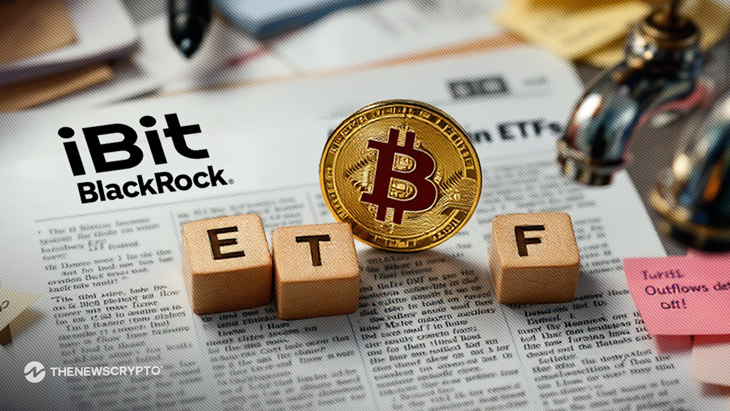
  • A mystery trader sold 29.2 million shares of BlackRock’s IBIT on Tuesday using dark pool.
  • The net outflow of $333.6 million occurred on the same trading day as the huge IBIT deal, continuing a streak of 11 trading days for US-listed Bitcoin ETFs.

Financial services firm NYDIG’s head of research, Greg Cipolaro, speculates that last week’s $1.26 billion block transaction in BlackRock’s iShares Bitcoin Trust (IBIT) was probably a whale quickly getting out of a directional move.

A mystery trader sold 29.2 million shares of BlackRock’s IBIT on Tuesday using dark pool, a private trading platform where institutions may covertly conduct big deals outside of public markets. This sparked suspicion over the motives and identities of the seller.

Several signs were “consistent with a large directional holder exiting a concentrated position rather than a contemporaneous basis-trade unwind,” according to a research note by Cipolaro. According to him, a big directional holding was likely selling since the seller accepted the offer for $1.01 less than the market price of $44.17, forewent $29.5 million to guarantee instant execution, and used a private trading platform.

Bitcoin ETF Outflows Continue

Major deals have the power to shift markets and influence public opinion. But in this instance, Bitcoin’s (BTC) value fell 2.8% on the trading day after the deal. Eric Balchunas, an ETF analyst for Bloomberg, said at the time that, despite the large block sell, the market took the sale very well.

The net outflow of $333.6 million occurred on the same trading day as the huge IBIT deal, continuing a streak of 11 trading days for US-listed Bitcoin ETFs, according to data from Farside Investors.

Since the last net inflow was observed across numerous funds on May 14, more than $2.9 billion has been pulled out of the ETFs. At the same time, public opinion has been all over the place. On Monday, the crypto market’s “fear” index—which gauges general opinion about cryptocurrencies—returned a score of 29 out of 100. For the month of May, it likewise averaged a “fear” rating.

Highlighted Crypto News Today:

JPMorgan CEO Slams Coinbase, Warns of Stablecoin Risks in Clarity Act
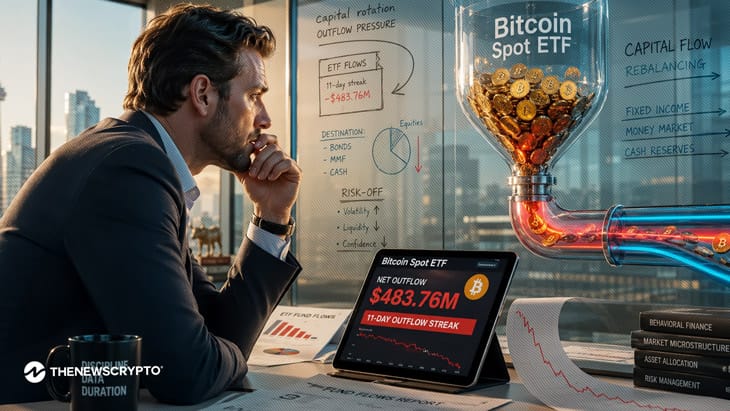
  • According to data source SoSoValue, investors pulled $3.45 billion over 11 trading sessions as bitcoin plummeted under $70,000 from US spot bitcoin ETFs.
  • This shift occurs at the same time when other indicators of institutional demand are showing signs of weakness.

After Monday’s admission of a minor BTC sale by Strategy (MSTR), the crypto markets continued to hemorrhage downward, with bitcoin (BTC) leading the pack.

Bitcoin was trading around $69,000 an hour before U.S. stock markets opened on Tuesday morning, reflecting a 4.5% decline over the previous 24 hours. Although the $60,000 low on February 6 was brief, there was a wick to the downside. The $63,000 level is likely to be the point at which markets begin to contemplate a “re-test” of the bottom.

Longest Redemption Streak

According to data source SoSoValue, investors pulled $3.45 billion over 11 trading sessions as bitcoin plummeted under $70,000 from US spot bitcoin ETFs, the longest withdrawal run on record. The record-breaking 11-session streak started on May 15, exceeding the eight-day record established in February 2025 and making it the longest stretch of net redemptions since the funds’ introduction in January 2024.

Stocks related to semiconductors and artificial intelligence continue to pique investors’ curiosity, and Wall Street’s penchant for risk is evident with Nvidia’s 6% gain. In the most recent session, investors pulled $484 million out of the funds, contributing to a 4% decline in the price of Bitcoin throughout the Asian trading day.

Although the transaction only accounted for a small portion of Strategy’s holdings, it was the first time the business had sold bitcoin since December 2022 and after months of buy-and-hold advocacy by Executive Chairman Michael Saylor.

This shift occurs at the same time when other indicators of institutional demand are showing signs of weakness. A growing number of people are opting to store bitcoin rather than purchase it, according to CryptoQuant’s most recent weekly analysis.

A further indicator that one of the main demand drivers supporting bitcoin’s surge may be dwindling is the present record ETF withdrawal streak, as pointed out by CryptoQuant, which follows a significant slowdown in ETF and corporate treasury accumulation in recent months.

Highlighted Crypto News Today:

Binance Unveils U.S. Stock Trading, Expands Push Into Tokenized Equities

USA Rare Earth announced definitive agreements with the US Department of Commerce that provide access to up to $1.6 billion in funding under the CHIPS Act to support the development of a domestic rare earth supply chain.

The agreements formalize an earlier announcement that the Trump administration would support a $1.6 billion debt-and-equity funding package for the company.

Despite the funding milestone, shares of USAR declined nearly 5.3% in morning trading.

The company said the funding framework will help accelerate development of its rare earth mining, processing, metal-making, and magnet manufacturing operations across the United States as Washington seeks to reduce dependence on China for critical minerals and rare earth materials.

Funding package expands support for growth plans

Under the agreements, USA Rare Earth will gain access to up to $277 million in federal funding and as much as $1.3 billion in senior secured loan capacity through the Commerce Department’s CHIPS program.

Disbursements will be tied to the achievement of project milestones, according to the company.

The funding adds to a $1.5 billion private capital raise completed in January.

Combined with previous fundraising efforts, USA Rare Earth said it now has approximately $3.5 billion in committed capital to support its expansion plans.

As part of the agreement with the Commerce Department, the company will issue 16.1 million common shares and 17.6 million warrants to the department.

The agreements come months after Chief Executive Officer Barbara Humpton told Reuters that the transaction was expected to close in April.

Round Top project central to expansion strategy

A significant portion of the funding will support the development of the company’s Round Top heavy rare earth and critical minerals project in Texas.

USA Rare Earth is targeting initial production from the project in 2028 as part of its broader effort to establish a fully integrated domestic supply chain.

The company said the agreements will also support processing and separation operations for materials produced at Round Top, including heavy rare earth element oxides, concentrates, and other critical minerals.

In addition, funding will be used to expand domestic metal-making, alloy production, and strip-casting capabilities.

The company plans to reshore 10,000 tons per year of heavy rare earth metal-making and alloy capacity as it builds out its mine-to-magnet strategy.

US aims to reduce dependence on China

The announcement comes as the United States continues efforts to strengthen domestic production of critical minerals and reduce reliance on China, which currently dominates global rare earth processing and magnet manufacturing.

USA Rare Earth earlier announced plans to invest $1.2 billion in a new magnet manufacturing and refined metals facility in South Carolina.

The project is expected to expand domestic production capacity and create hundreds of jobs.

The Commerce Department funding will also support the scaling of neodymium-iron-boron (NdFeB) magnet manufacturing operations in Oklahoma and South Carolina to a combined capacity of 10,000 tons per year.

USA Rare Earth said its objective remains the creation of an integrated US rare earth supply chain spanning mining, processing, metal production, and magnet manufacturing.

The post USA Rare Earth secures up to $1.6B CHIPS funding for US expansion appeared first on Invezz

The iShares 20+ Year Treasury Bond ETF (TLT) and the iShares 0-3 Month Treasury Bond ETF (SGOV) have diverged this year in terms of their inflows and outflows. This situation has escalated this year as the US-Iran war has continued, pushing inflation to the highest levels in years.

TLT ETF has shed $4.3 billion in assets

The iShares 20+ Year Treasury Bond ETF has been one of the worst-performing funds this year. Its stock has dropped by over 45% from its all-time high, and is hovering near its record low. 

Data shows that the ETF has shed over $4.3 billion in assets this year, bringing its assets under management (AUM) to $42 billion.

This performance mirrors that of other long-term US government bonds like the Vanguard Long-Term Treasury Index Fund (VGLT), which has shed billions of dollars in assets this year.

There are two main reasons for this. First, US government bond yields have soared in the past few months. The 30-year government bond yield jumped and crossed the 5% mark in May. While the yield has pulled back for now, analysts believe that it will keep soaring in the foreseeable future.

The main risk for the bond yields is that the public US debt has soared and will soon cross the $40 trillion mark. The Supreme Court has already ruled against Trump’s tariffs that would have led to more government revenue over time. While Trump has tools to impose tariffs, they are less effective than the ones he used.

Investors have also dumped long-term bonds because of the falling US reputation that has pushed some countries to avoid these purchases. China has reduced its US bond holdings from over $1.3 trillion to below $700 billion. 

This situation escalated after the start of the Russian-Iranian war, when US sanctioned Russia’s central bank assets. China believes that the US government may do the same when it launches its operation to take over Taiwan.

There was risk that some European countries would also start dumping their US bonds as Trump threatened to invade Greenland. Also, the ongoing Iran war means that some Gulf countries will reduce their exposure to the US.

SGOV and BIL ETFs are thriving

The ongoing TLT ETF outflows is happening at a time when investors are piling into short-duration funds. Data shows that the iShares 0-3 Month Treasury Bond ETF (SGOV has added over $23 billion in assets, bringing its assets to over $90 billion.

Similarly, the SPDR Bloomberg 1-3 Month T-Bil (BIL) ETF has added over $2.9 billion in assets this year, bringing its total assets to over $45 billion.

These funds, which resemble money market funds, have added substantial assets this year because of the elevated government bond yields amid the rising inflation. Data shows that the US Government 1 Month Government Bond Yield stands at 3.8%, which is quite attractive to income investors. 

This trend aligns with the ongoing inflows into money market funds. Data by FRED shows that the US money market assets under management has jumped to over $8.19 trillion this year from $7.2 trillion on the same day last year

Still, investors piling into BIL and SGOV are missing the strong rally in the stock market. Data shows that the BIL ETF has had a total return of 1.46% this year, while SGOV and TLT have returned 1.50% and 0.15%, respectively. In contrast, the S&P 500 and Nasdaq 100 indices have jumped by double digits.

The post What’s behind the growing exodus from TLT ETF into SGOV and BIL? appeared first on Invezz

Real Finance, an EVM-compatible Layer 1 blockchain built for real-world asset tokenization, has announced a strategic partnership with Anchorage Digital, which operates the first federally chartered crypto bank in the United States and serves as a qualified institutional custodian.

The partnership is intended to support the full lifecycle of tokenized assets, including issuance, custody, settlement, servicing, and secondary-market liquidity.

Under the agreement, Anchorage Digital’s regulated custody, treasury management, settlement, and institutional security capabilities will be combined with Real Finance’s issuance infrastructure, lifecycle management tools, risk visibility framework, and programmable financial infrastructure.

The partnership will focus on several areas across the tokenized asset ecosystem:

Treasury and ecosystem custody: Anchorage Digital will provide regulated custody and treasury infrastructure for the Real Finance ecosystem and its native $ASSET token.

Foundational custody layer: As new tokenized financial instruments are launched on the Real Finance Layer 1 blockchain, Anchorage Digital is expected to serve as a custody layer supporting broader institutional participation.

Mutual pipeline support: The two companies will collaborate on institutional onboarding and business development. Real Finance aims to generate additional demand for regulated custody through its asset issuers and tokenization initiatives, while Anchorage Digital will connect institutional clients with tokenization and blockchain infrastructure solutions built on Real Finance.

Ivo Grigorov, CEO of Real Finance, said: “Real Finance and Anchorage Digital are collaboratively building the institutional infrastructure for the next generation of tokenized financial markets. Tokenization alone is not enough. Institutions need trusted, regulated layers that integrate custody, servicing, settlement, and lifecycle management. Together we are moving the industry from experimentation toward functional on-chain capital markets and delivering the unified experience institutions demand.”

Nathan McCauley, Co-Founder and CEO, Anchorage Digital, said: “RWAs are one of the clearest examples of how blockchain can modernize capital markets, but institutions need more than tokenization rails alone. They need regulated, secure infrastructure that can support custody, settlement, and lifecycle connectivity at scale. Our partnership with Real Finance brings together the core building blocks institutions need to move from isolated pilots to real onchain capital markets.”

As real-world assets increasingly move on-chain, institutions require more than tokenization infrastructure alone.

The tokenized asset market remains fragmented across areas such as issuance, custody and compliance, settlement, servicing, and liquidity.

According to the companies, operational trust and disconnected service providers continue to be among the key barriers to the development of fully functional on-chain capital markets.

Real Finance and Anchorage Digital said the partnership is intended to address these challenges by bringing together blockchain infrastructure, regulated custody, treasury management, settlement services, and tokenization capabilities within a more integrated framework.

The companies said the model is designed to support a range of tokenized assets and financial products, including private credit, investment funds, real estate, structured products, and bank-integrated financial instruments.

The post Real Finance, Anchorage Digital partner on tokenized asset infrastructure appeared first on Invezz