
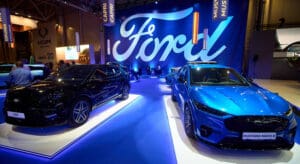

Ford Motor Company has been overtaken in global vehicle sales for the first time by Chinese electric car giant BYD, underscoring the dramatic shift under way in the global automotive industry.
Ford’s sales slipped 2 per cent last year to just under 4.4 million vehicles, while BYD sold 4.6 million, climbing to sixth place in the global rankings of car manufacturers.
The milestone is symbolic for an industry shaped by Ford’s legacy. Founder Henry Ford revolutionised mass car ownership with the Model T in the early 20th century. More than a century later, the company that defined industrial car production is being outpaced by a Chinese electric vehicle specialist.
BYD’s growth has been driven by its expanding portfolio of affordable, high-tech electric and plug-in hybrid vehicles. Among its best sellers are the SEAL U DM-i and the Dolphin electric city car, priced at under £19,000 in some markets.
In contrast, Ford has scaled back lower-cost small cars in Europe, phasing out the Ford Fiesta during the pandemic and pivoting towards higher-margin SUVs and crossovers. Its entry-level Puma now starts at more than £26,000.
Ford’s sales in the US rose, but the company has lost ground in Europe and China — markets where electric competition is intensifying.
Felipe Munoz, an independent automotive analyst, said the trend was widely anticipated. “BYD is still in expansion mode. Even if sales in China slow, it’s relying on exports to grow,” he said.
“Ford, meanwhile, remains heavily dependent on the US, where growth is modest, and has only a minor presence in China. Europe is also stagnant. This divergence is likely to continue.”
Western carmakers, including Ford, have struggled to navigate the electric vehicle transition. In December, Ford took a $19.5bn (£14bn) charge to scale back EV production, citing weaker-than-expected demand.
Munoz said Ford’s electrification strategy was complicated by its exposure to North America. “North American consumers are not enthusiastic about electric cars, and government support has been inconsistent,” he said.
Ford has attempted to regain a foothold in China through a joint venture with Jiangling Motors, launching an all-electric version of its Bronco SUV. However, its Chinese market share has fallen from nearly 5 per cent a decade ago to less than 2 per cent today.
“Let’s see how the Bronco Electric performs,” Munoz said. “But so far, nothing significant has changed.”
Despite global challenges, Ford remains Britain’s third-largest car brand. According to the Society of Motor Manufacturers and Traders, it sold about 119,000 vehicles in the UK in 2025, representing a 5.9 per cent market share, an 8 per cent increase on the previous year.
BYD, while still smaller in the UK, is growing rapidly. It sold around 51,400 cars last year, achieving a 2.5 per cent market share, but with sales rising almost sixfold.
At the top of the global league table, Toyota retained its crown for the sixth consecutive year with sales of 11.3 million vehicles.
For Ford and other Western manufacturers, BYD’s ascent signals more than just a ranking shift, it reflects a deeper rebalancing of power in an industry increasingly defined by electrification, cost efficiency and Chinese technological ambition.
Read more:
Ford overtaken by BYD as China reshapes global car industry